
Rose Center for Earth and Space
West 81st Street @ Central Park West
New York, NY 10024
(212) 769-5100 general information • 769-5200 advance tickets/group sales
www.amnh.org/rose/

The American Museum of Natural History's Rose Center for Earth and Space had its grand opening in February 2000, and this world class science center features, among a variety of very cool, high-tech exhibits, the new Hayden Planetarium. The Hayden has been delivering the ultimate in astronomical exhibits and sky shows to the public since 1935. Now, completely redesigned and rebuilt as part of the $210 million Rose Center, the famous planetarium promises an experience not soon to be forgotten.
 Hayden Planetarium
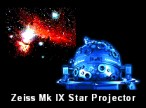
The most remarkable facility of its type in the world, the new Hayden Planetarium features the most technologically advanced Space Theater in existence. Located in the top half of the 87-foot Hayden Sphere, the theater features the Zeiss Mk IX Star Projector. Uniquely customized for the Hayden, the Zeiss Mk IX creates shows of unparalleled realism, making the Hayden Planetarium the largest and most powerful virtual reality simulator in the world.
Passport to the Universe, the inaugural Space Show narrated by two-time Academy Award winner Tom Hanks, presents hyper-realistic views of our night sky, as seen from Earth. The Digital Dome System flies audiences through a scientifically accurate virtual re-creation of our Milky Way Galaxy and beyond, to the "edge" of the observable universe.
 The Big Bang
The popular theory of the creation of the universe is brought to life in the bottom half of the Hayden Sphere, where visitors will be transported to the beginning of time and space, in a dramatic, multi-sensory re-creation of the first moments of the universe. Two-time Academy Award winner Jodie Foster narrates dramatic audio and visual effects, including a brilliant laser display, that re-create how the universe began in a burst of radiant energy from a point smaller than a grain of sand. An awe-inspiring journey through the growth of the universe follows, as visitors walk the Harriet and Robert Heilbrunn Cosmic Pathway — and discover 13 billion years of cosmic evolution. An average stride covers 75 million years. All of recorded history is but the width of a single human hair.
The Scales of the Universe walkway hugs the glass walls of the Rose Center and features differently scaled models that illustrate the relative size of cosmic and human objects, from galaxies, stars and planets, to the human brain and nucleus of the smallest atom. The 400-foot long walkway ingeniously uses the Hayden Sphere for size comparison.
Gottesman Hall of Planet Earth
Organized into five major exhibit areas, the Hall of Planet Earth utilizes a variety of media, from rock samples through state-of-the-art computer and video displays, to answer the major questions about the processes that formed our planet and continue to shape it today:
- How has the Earth evolved?
- Why are there ocean basins, continents and mountains?
- How do we read the rocks?
- What causes climate and climate change?
- Why is Earth habitable?
Visitors will also see 168 rock specimens and 11 full-scale models of classic outcroppings from 25 different countries and five ocean floors regions. Interactive displays allows visitors to both explore geologic time and gain insight into the methods scientists use to study vast Earth systems.
The lower level of the Rose Center features the Cullman Hall of the Universe. Here, visitors will explore four distinct zones: Universes, Galaxies, Stars, and Planets. The stories of modern astrophysics are revealed through thematic clusters that illustrate phenomena such as colliding galaxies, supernova explosions, the expanding universe, and more. Some of the highlights include:
- AstroBulletin -- a large video screen displaying the latest imagery from observations around the world, NASA, the Hubble Telescope, and other spacecraft.
- Ecosphere - Features a sealed complete ecosystem to explore the possibility and conditions for life to exist elsewhere in the universe.
- Willamette Meteorite - Visitors can see and touch this ancient 15 and one-half ton meteorite.
Finally, the Rose Center and the American Museum of Natural History featuring gifts, specialty items, scientific instruments, and much more.
| Hours: Open daily 10am - 5:45pm. Closed Thanksgiving and Christmas. | ||
Admission:
|
||
Groups:
|
||
| Group Reservations: At least 2 weeks in advance. Schools at least 4. | ||
| Lunch: Great food served in Garden Cafe restaurant or Dinersaurus fast food. | ||
| Handicapped Access: Accessible. | ||
| Directions: Located at West 79th St. and Central Park West. Public Transportation info available at above number. 30 minutes south of the George Washington Bridge. | ||
Copyright © 1996-2014 by Patrick Tadeushuk. All Rights Reserved.